
The space
between the parts.
Connection
It is easy to describe a system as a list: an arm, a sensor, a controller, a tool. What makes it useful is the way those parts work together.
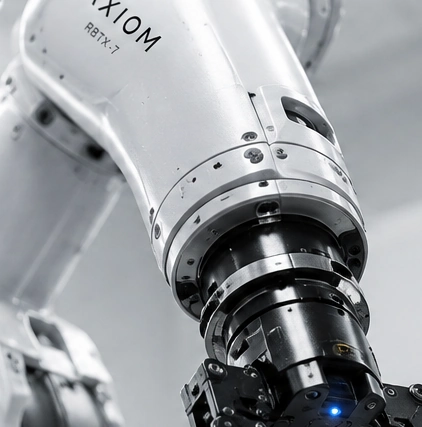
Design the handover.
Consider the moment between a decision and a movement, between one station and the next, between an automated sequence and a person’s intervention. Each connection needs a clear purpose.
What information crosses that boundary? Who or what is responsible for the next step? What happens if the expected response does not arrive? These are system questions, not finishing touches.
Make the whole understandable.
A team should be able to explain what the system is doing, what it is waiting for and what will happen when something changes. Clarity is part of the engineering brief, not a layer added at the end.
The explanation needs to work for the people who operate, maintain and develop the system. Their questions may be different, but the underlying behaviour should form one coherent picture.
Not more parts.
A clearer relationship between them.
Keep the exception inside the design.
Every sequence has moments where the next action is uncertain. An object may not be where it was expected. A check may be inconclusive. A person may need to pause the work. Define those conditions as part of the system’s intended behaviour.
The response needs to be specific to the application. It can include stopping, asking for information or handing control to an authorised person. The important point is that recovery is designed, assessed and validated rather than left implicit.
Leave room for the next question.
Tasks evolve. Products change. A useful concept asks which parts should remain stable and which should be able to adapt. Making that distinction early creates a better conversation about the next stage of development.
The ambition is a connected system that makes sense in the world around it. Its value is not the number of components it contains, but the clarity and purpose of the relationship between them.
An AXIOM design perspective, not a customer case study or a product specification. Any application requires project-specific engineering, assessment and validation.